.png)
Designing and Evaluating Robot-Supported Reading Activities in Primary Education
Praxis der Forschung (PdF), Winter Semester 2026/27
Supervisors: Dr. Utku Norman (ITAS), Dr. Irina Rudenko (IAR-SARAI), and Prof. Dr. Barbara Bruno (IAR-SARAI)
Background
Reading fluency, accuracy, and comprehension are fundamental components of literacy development in primary education. Recent advances in social robotics and AI create new opportunities to support reading activities through social interaction, physical embodiment, and adaptive feedback. Yet important questions remain regarding how social robots can meaningfully support learning in real classrooms, how their use can be sustained and refined over time, and what opportunities and challenges emerge as teachers and children engage with them in educational settings.
|
Figure 1. Pilot study of robot-supported foreign-language reading activities with adult learners. Left: interaction setup. Right: example reading material presented during the study. The present project adapts and extends this work to the context of primary education. Ethical approval was granted by the KIT Ethics Committee (No. A2026-063). |
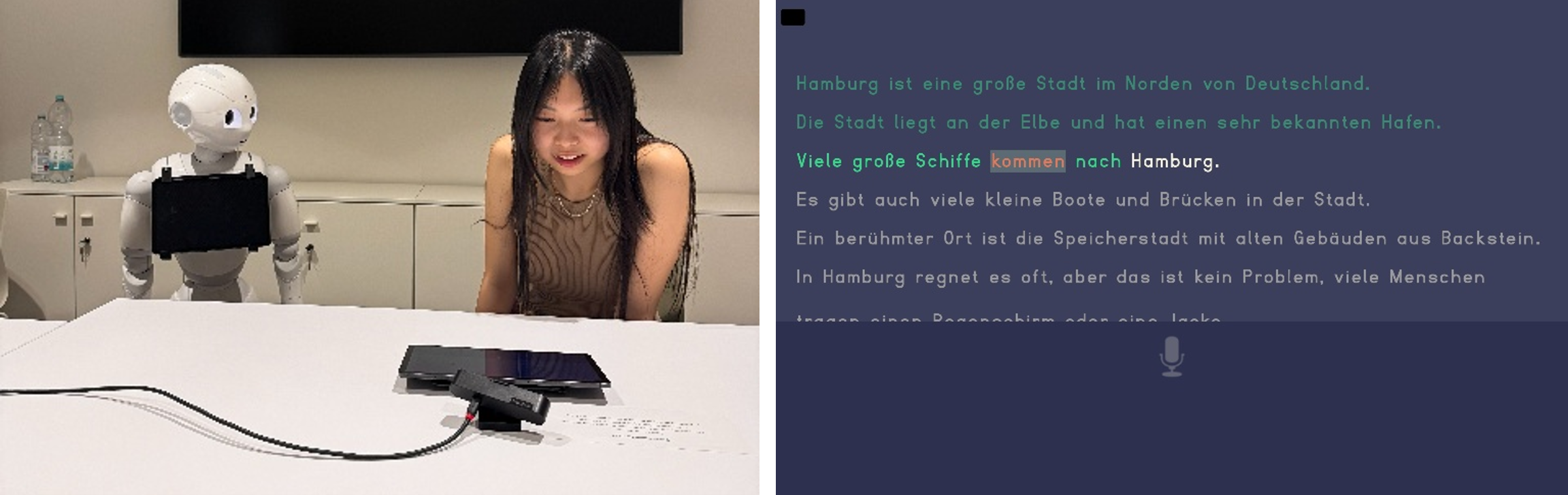
This project builds on ongoing prototype development and a long-term collaboration with a local primary school, providing opportunities to design, deploy, and evaluate robot-supported reading activities in real educational settings.
Project Description
This project investigates how social robots can support children’s learning to read in primary education. Building on ongoing prototype development and a long-term collaboration with a local primary school, students will design, refine, deploy, and evaluate robot-supported reading activities in educational settings.
The proposed project aims to develop a cooperative robotic system to support children in developing their reading skills. The reading activity will involve children reading selected materials on a tablet while the robot follows their reading. When the system detects a reading error, the robot will ask the child to stop and repeat the relevant word. The robot’s role will not be to teach directly, but rather to act as a cooperative and supportive partner, providing feedback and encouragement throughout the reading activity.
A central function of the proposed robotic system will be to incorporate a range of reading tasks developed in cooperation with teachers and adapted to different levels of children’s reading skills. These tasks will range from basic activities, such as reading individual syllables and words, to reading longer and more complex texts. The system will also include comprehension-checking activities based on prepared questions related to the reading material.
Core Project Goals
The project has three main goals:
- To design and implement a robotic system that supports and enables different levels and types of reading activities, ranging from basic syllable-based reading to longer texts and reading-comprehension tasks.
- To design and evaluate child-robot interaction strategies that support the development of children's reading skills, providing appropriate feedback, encouragement, and interaction as children progress through increasingly challenging reading activities.
- To conduct user studies with children and teachers in educational settings to evaluate the usability, usefulness, acceptance, and educational value of robot-supported reading activities.
Research Questions
- How can social robots support reading activities and reading skills development in primary education?
- How are robot-supported reading activities experienced by children and teachers?
- How can reading activities be refined through classroom use and teacher feedback?
- What enables or constrains the meaningful use of social robots in educational practice over time?
Research Activities
Students may contribute to:
- Design and refinement of robot-supported reading activities
- Interaction design and user experience evaluation
- Classroom deployments and user studies with children and teachers
- Qualitative and quantitative data collection and analysis
- Scientific dissemination through reports, presentations, and publications)